

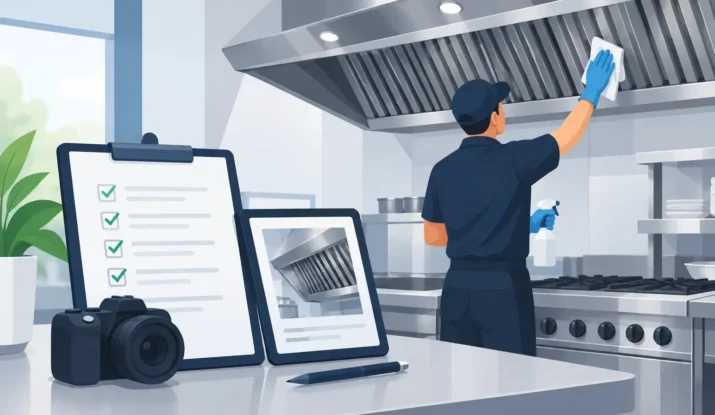
A clean kitchen exhaust system is only part of the job. When an inspector, property manager, insurer, or corporate facilities team asks when the system was last serviced, your records need to provide a clear answer. Knowing how to document hood cleaning protects your operation by creating a reliable record of maintenance, identifying unresolved issues, and showing that grease-management responsibilities are being handled consistently.
For Las Vegas restaurants, casinos, hotels, and high-volume commercial kitchens, documentation should be treated as part of the cleaning service, not an afterthought. The right paperwork helps managers stay ahead of scheduled service, supports fire-code compliance, and prevents confusion when staff, vendors, or ownership changes.
Why hood-cleaning documentation matters
Grease accumulation in hoods, ducts, and exhaust fans is a fire hazard. Professional cleaning reduces that hazard, but an undocumented service can create problems later. If there is no clear service record, a kitchen may struggle to verify maintenance during a fire inspection or after an incident.
Good documentation also creates accountability. It confirms what areas were accessible, what equipment was cleaned, what conditions were found, and whether any repairs or follow-up work are needed. This is especially useful in facilities with multiple kitchens, several tenants, or rotating management teams.
Cleaning frequency depends on the type and volume of cooking, the fuel used, the menu, and applicable fire-code requirements. A 24-hour resort kitchen, for example, may require more frequent service than a small operation with limited cooking. Your documentation should show that the cleaning schedule matches the actual grease load and operating conditions of the kitchen.
How to document hood cleaning after every service
The most dependable approach is to create a complete service record immediately after the work is finished. The person performing or overseeing the cleaning should document the service while details are fresh, not days later from memory.
A useful record begins with the basic job information: the facility name, street address, kitchen or unit identification, date of service, arrival and completion times, and the name of the technician or company performing the work. Include the manager or employee who provided access when possible. These details establish where and when the service occurred.
The report should then identify the exhaust system that was cleaned. In a smaller restaurant, that may be one hood line. In a hotel, food court, or casino property, it may include several hoods serving separate cooking areas. Labeling each system by kitchen, hood number, or equipment line prevents records from becoming vague and difficult to use.
Record the full scope of work
A hood-cleaning report should state which components were serviced. Rather than writing only “hood cleaned,” identify the surfaces and sections included in the work. This commonly includes the hood canopy and plenum, removable filters, accessible horizontal and vertical ductwork, exhaust fan components, grease containment components, and accessible rooftop areas affected by the work.
Be accurate about what was accessible and what was not. Access limitations can affect the final result and should never be hidden in a generic report. A blocked access panel, a sealed duct section, roof restrictions, damaged hinges, or equipment installed beneath a hood may prevent proper cleaning. Note the condition, location, and recommended correction so the operator has a clear path forward.
Do not confuse cleaning with repair. If a technician observes a damaged access door, missing fan hinge kit, leaking grease containment unit, or other mechanical concern, document it as an observation or recommendation. Unless repair work was specifically completed, the report should not suggest that it was.
Use before-and-after photos with purpose
Photos are one of the strongest pieces of supporting documentation when they are organized correctly. Take clear images before cleaning where grease buildup, problem areas, or access conditions need to be shown. After cleaning, photograph representative finished areas, including the hood interior, filters, accessible duct access points, and exhaust fan or rooftop grease-control components when applicable.
A photo should answer a practical question: What does this image prove? Wide shots establish location. Close-up shots show grease conditions, damage, or finished cleaning. If your camera or mobile device records date and time data, retain the original files whenever possible.
Avoid taking dozens of repetitive photos with no labels or connection to the report. A smaller set of useful images is better than an unorganized camera roll. Name photo files by location, system, and service date, such as “Main Kitchen Hood 1 – 2026-09-15.” For multi-unit facilities, include the suite, kitchen, or tenant name.
Document deficiencies and recommendations clearly
A service report should help the customer act on conditions that affect safety or future maintenance. The language needs to be specific and professional. “Fan issue” is not useful. “Exhaust fan hinge kit is damaged and fan cannot be safely opened for complete duct access” gives the operator meaningful information.
Common deficiencies worth documenting include inaccessible duct sections, missing or damaged access panels, heavy grease leakage at the fan, deteriorated rooftop grease containment, electrical issues affecting the fan, damaged filters, or obstructions that prevent safe access. If a deficiency presents an immediate safety concern, tell the on-site manager directly and record that notification on the report.
Recommendations should distinguish between urgent corrections and routine improvements. For example, a missing access panel may require prompt attention to allow future cleaning, while an upgraded grease-containment program may be a preventive measure based on rooftop conditions. Clear priorities make it easier for busy operators to make decisions and avoid neglected repairs.
Include the inspection label and service verification
After a system has been cleaned to the required standard, the appropriate hood-cleaning service label should be completed and placed where it can be seen. The label generally identifies the servicing company and the date of service. It serves as a quick visual reference for kitchen staff and inspectors, but it should not be the only record you keep.
The detailed report, photos, invoice, and any deficiency notices should be retained with the label information. If a fire authority, building representative, or risk manager needs more than the date of the last cleaning, you will have supporting documentation ready.
Some facilities also require a manager signature or digital acknowledgment. This can be helpful, particularly when the report notes access limitations or recommended repairs. The signature should confirm receipt of the report, not imply that every issue has been corrected.
Organize records so they are easy to retrieve
Documentation only works if someone can find it. Keep records in a consistent system that allows you to search by property, kitchen, hood system, and date. Digital files are generally easier to retain and share than paper files, but the method matters less than consistency.
For each service visit, keep the completed report, photographs, invoice or work order, inspection-label details, and records of any follow-up repairs. If the system is cleaned on a recurring schedule, maintain a running service history. That history can reveal changes in grease buildup, recurring access issues, missed appointments, and signs that the current cleaning frequency should be adjusted.
Large operators often benefit from a single folder or log for each location. Smaller restaurants can use a simpler format, as long as records are protected from loss and available to the people responsible for maintenance. Do not rely on a former manager’s email inbox or a stack of unsigned invoices in the office.
Make documentation part of your vendor standard
When selecting a hood-cleaning provider, ask what documentation is included after service. A professional contractor should be able to explain how they record the scope of cleaning, deficiencies, photographs, and service verification. Honest reporting matters because a report that ignores access problems or grease conditions does not protect the customer.
At Vegas Pressure Clean, hood cleaning is approached as a fire-safety service, not a surface-level wash. Clear job documentation supports that standard by giving operators a practical record of the work completed and the conditions that need attention.
Assign one person on your team to review each completed report, schedule corrections for noted deficiencies, and file the records in a consistent location. That small operational habit can make the next inspection, ownership transition, or maintenance decision far less stressful.