

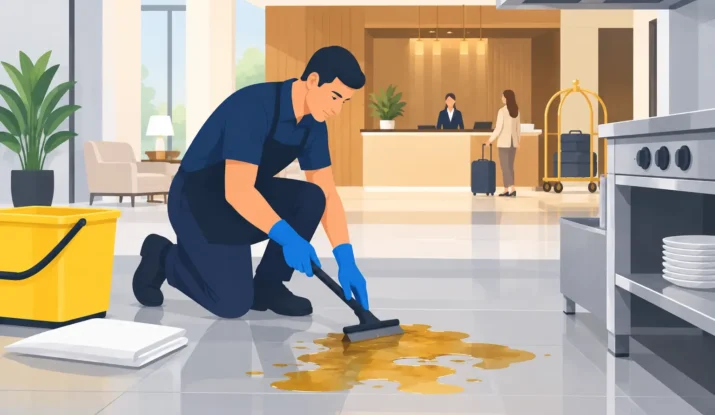
A grease spill near a hotel kitchen is not a routine janitorial issue. A proper hotel grease spill response protects employees from falls, keeps grease out of drains and guest areas, limits fire-related hazards, and helps the property avoid a service disruption during a busy shift. In Las Vegas hotels, where kitchens may support restaurants, banquet operations, room service, pools, and conventions at the same time, a small spill can become a larger operational problem quickly.
The right response begins with containment, not mopping. Staff need clear authority to secure the area, stop the source, and bring in qualified cleanup support when the spill exceeds what on-site personnel can safely manage.
Why hotel grease spills require fast action
Grease creates an immediate slip hazard on tile, sealed concrete, quarry tile, loading docks, and walk-in cooler floors. It can travel farther than expected under shoes, cart wheels, and equipment casters. Once it reaches a hallway, receiving area, elevator threshold, or exterior walkway, the exposure extends beyond the kitchen team.
The risk is not limited to slips and falls. Grease that enters floor drains can contribute to plumbing blockages and grease interceptor problems. Grease left under fryers, ranges, or cooking equipment can become fuel for a fire. If the spill is related to an overflowing container, failed fitting, damaged equipment, or a grease-laden exhaust issue, the underlying cause also needs attention before operations return to normal.
Hotels have another concern: guest experience. A blocked service corridor, odors near public spaces, or emergency cleanup activity around an event kitchen can affect the operation well beyond the back of house. Fast, controlled action protects both safety and continuity.
The first 15 minutes of hotel grease spill response
The first response should be simple, deliberate, and consistent. Do not allow staff to rush in with a wet mop or hose down the area. Water can spread grease across a larger surface and may carry it into drains.
A trained manager or designated employee should take these actions:
- Stop the source if it can be done safely, such as shutting off equipment, uprighting a container, or closing a valve.
- Restrict access with cones, wet-floor signs, barriers, or a staff member controlling the area.
- Protect drains with drain covers, absorbent barriers, or other suitable containment materials.
- Use absorbent material to capture free-standing grease before applying a degreaser or cleaning solution.
- Notify engineering, facilities, security, or the appropriate hotel leadership contact based on the spill location and severity.
For a minor spill in a contained kitchen work area, this process may be enough to stabilize the scene until cleanup is completed. For a larger release, a spill near public areas, grease entering drains, or a spill involving hot oil, damaged equipment, or fire suppression concerns, escalation is the safer choice.
Protect people before protecting the floor
Employees should wear appropriate slip-resistant footwear and gloves. If the product is hot, personnel also need protection from burns. Keep untrained staff out of the cleanup area, particularly when a spill has moved under equipment or into a confined space where visibility is poor.
A common mistake is moving heavy cooking equipment immediately to reach grease underneath. That can damage gas, electrical, water, or fire suppression connections. Engineering or a qualified service provider should assess equipment movement when the spill is substantial or the source is unclear.
Containment matters more than speed alone
Speed is valuable, but uncontrolled cleaning can create a bigger problem. The goal is to keep grease contained on the surface until it is collected and removed properly. That means working from the outside edge toward the center, preventing traffic through the area, and protecting nearby drains before liquids are introduced.
Absorbents are often the right first tool for pooled grease. Once the free product is removed, a commercial degreasing process can address the remaining film. The exact method depends on the flooring, the volume of grease, the temperature of the material, and whether the spill reached grout lines, equipment bases, walls, drains, or exterior concrete.
High-pressure washing is not automatically the answer. In an interior kitchen, improper pressure washing can force grease into gaps, electrical areas, floor drains, or adjacent work zones. Exterior concrete may require a different process that captures wash water and prevents grease from moving into storm drains. The cleanup method should match the site conditions, not simply the appearance of the spill.
When to call a professional grease cleanup team
Hotel maintenance teams handle many day-to-day cleaning tasks well. Still, there is a point where professional grease spill cleanup is the responsible operational decision. Call for qualified help when the spill is large, recurring, near drains, under fixed equipment, outside in a loading or guest-access area, or connected to an equipment failure.
Professional support is also appropriate when the kitchen needs to reopen quickly and the hotel cannot pull key staff away from food production. A trained commercial cleaning team can bring the right degreasers, containment materials, recovery equipment, and labor to clean the affected area without turning a spill into an all-shift disruption.
For properties with heavy cooking volume, the source of the spill deserves as much attention as the floor. Grease may be escaping from a fryer filtration process, a leaking grease container, an overloaded interceptor area, improperly maintained equipment, or accumulated buildup around cooking lines. Repeated spills are a maintenance warning, not just a housekeeping issue.
Check the exhaust system when grease is part of the pattern
A spill on the floor does not always begin on the floor. Excess grease around hoods, ducts, filters, fans, and rooftop exhaust components can indicate that the exhaust system needs attention. Grease accumulation increases fire risk and can drip onto cooking equipment or nearby surfaces if cleaning intervals are not adequate.
Hotel operators should ensure kitchen exhaust systems are cleaned at intervals appropriate for their cooking volume and type of operation. The goal is not only a cleaner hood. It is a safer system that supports fire-code compliance and helps prevent grease from migrating into areas where it does not belong.
Document the incident before details are lost
Once the area is safe, document what happened. This does not need to be complicated, but it should be consistent. Record the date, time, location, likely source, estimated size of the spill, people notified, cleanup actions taken, and whether any grease reached a drain or public area.
Photos taken after the area is secured can help facilities teams identify recurring issues and verify the condition of the space. If an employee or guest was exposed to a slip hazard, follow the property’s incident reporting process promptly. Clear records support maintenance planning, vendor coordination, and internal accountability.
Documentation is especially useful in large hotel operations where the kitchen, engineering, safety, and housekeeping teams may all have a role. Without a clear report, the immediate mess may be cleaned while the leaking equipment or process failure remains unresolved.
Build prevention into the hotel’s maintenance routine
The best grease spill response plan includes prevention. Managers should inspect high-risk areas regularly: beneath fryers and ranges, around grease collection containers, near floor drains, in receiving and loading areas, and along routes used to transport grease or cooking oil. Look for residue before it becomes a pooled spill.
Staff training should cover who has authority to stop work, where containment supplies are kept, how to protect drains, and when to call management or outside support. Spill kits should be easy to reach, clearly stocked, and checked routinely. A kit stored in a locked room on another floor will not help during a dinner rush.
Scheduled cleaning also plays a practical role. Degreasing equipment exteriors, kitchen floors, service corridors, dumpster pads, and grease-prone concrete reduces the buildup that turns routine traffic into a hazard. For exhaust systems, work with a qualified provider that understands fire safety requirements and can document the cleaning performed.
Vegas Pressure Clean helps commercial kitchens and hotel foodservice operations address grease hazards with focused, professional cleaning support. The priority is straightforward: contain the risk, clean the affected area correctly, and help the operation return to service without compromising safety or compliance.
A hotel does not need to wait for a major incident to improve its response. Assign clear roles, keep containment supplies where crews can reach them, and treat recurring grease as a maintenance issue that deserves a permanent fix.