

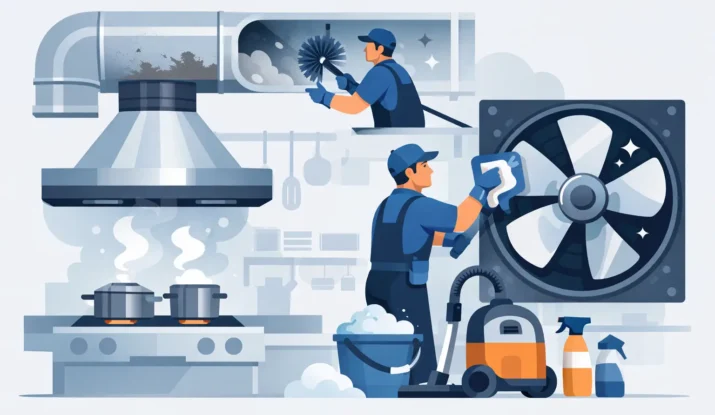
A failed inspection rarely starts with what you can see under the hood. More often, the real problem is farther up the line – grease packed into the ductwork and coating the exhaust fan. That is why a solid duct and fan cleaning guide matters for any commercial kitchen running long hours, high heat, and heavy grease load.
For restaurant owners, kitchen managers, and facility teams, exhaust cleaning is not cosmetic maintenance. It is a fire-safety requirement tied directly to code compliance, equipment performance, and day-to-day operational risk. When the system is neglected, grease buildup does more than create a dirty kitchen. It increases fire danger, reduces airflow, strains equipment, and can put your business in a bad position during an inspection.
What a duct and fan cleaning guide should actually cover
A useful duct and fan cleaning guide should start with the full exhaust path, not just the hood canopy. In a commercial kitchen, grease-laden vapors move from the cooking line into the hood, through the duct, and out to the exhaust fan. If one section is cleaned while the rest is ignored, the system is still carrying risk.
That matters because grease does not build evenly. A kitchen with heavy charbroiler use may see rapid accumulation near the hood plenum and fan. A high-volume fryer operation may create buildup throughout the entire run. The layout of the duct, the type of cooking, and the number of operating hours all affect how quickly contamination develops.
A proper cleaning scope usually includes the hood interior, accessible ductwork, access panels, fan housing, fan blades, and roof area impacted by grease discharge. In some facilities, hinge kits or improved access points are also part of the conversation because without safe access, thorough cleaning is harder to achieve.
Why grease in ducts and fans is a serious hazard
The biggest concern is fire. Grease is fuel, and the exhaust system is designed to pull heat, smoke, and vapor away from cooking equipment. When grease accumulates inside the duct and around the fan, a flare-up at the cook line can spread beyond the appliance and into the exhaust path.
That is why code-driven cleaning schedules exist. This is not a matter of preference or housekeeping standards. It is about reducing the chance that a routine cooking incident becomes a much larger fire event.
There are operational costs as well. Restricted airflow can affect capture and containment at the hood, which means more smoke and heat staying in the kitchen. Fans working against heavy buildup may run less efficiently, and over time that can contribute to wear, service calls, and avoidable downtime. Staff also notice the effects before management sometimes does – hotter lines, lingering odors, and a kitchen that never quite feels clean.
How often commercial kitchen exhaust systems should be cleaned
There is no single schedule that fits every kitchen. Cleaning frequency depends on cooking volume, food type, operating hours, and the amount of grease vapor the system handles.
A kitchen running around the clock with solid-fuel cooking will need more frequent service than a light-duty operation with limited grease production. Fast casual concepts, hotel kitchens, franchise locations, and high-output restaurants often need recurring service on a tighter interval simply because the system loads faster.
This is where operators can get into trouble by relying on guesswork. If your hood looks acceptable from the line, that does not mean the duct and fan are in good shape. The only reliable schedule is one based on actual system condition, code requirements, and the realities of your menu and production volume.
Signs your system is overdue for cleaning
Some warning signs are obvious. Grease dripping from the hood, visible residue near access panels, and heavy coating on the fan base all indicate overdue service. Others are easier to dismiss until they start affecting operations.
If smoke is not clearing the way it should, if odors linger after the kitchen closes, or if the line feels hotter than normal, the exhaust system may not be performing as it should. You may also see grease on nearby rooftop surfaces or staining around fan components. In a busy kitchen, these signs tend to build gradually, which makes them easy to normalize.
Inspection pressure is another signal. If you are preparing for a fire inspection, insurance review, facility audit, or brand-standard check, waiting until the last minute is risky. A neglected duct and fan system usually does not improve with a quick wipe-down.
What proper cleaning looks like in practice
A professional exhaust cleaning should remove grease from the entire accessible system, not just improve the appearance of the hood. The work needs to be thorough, contained, and planned around the realities of a working kitchen.
That typically starts with protecting surrounding surfaces and equipment before cleaning begins. The hood, duct access points, and fan assembly are cleaned using methods suited to the degree of buildup and the configuration of the system. In commercial environments, experience matters because not every system has the same access challenges, roof setup, or grease load.
Documentation also matters. For many operators, proof of service is almost as important as the cleaning itself. Service records help support compliance, maintenance planning, and accountability across multi-unit or managed facilities.
A serious provider should be able to explain what was cleaned, what was observed, and whether any access, repair, or scheduling issues need attention before the next visit. That level of clarity helps prevent surprises during inspections.
The trade-off between in-house cleaning and specialist service
Kitchen staff can and should handle routine surface cleaning around the cooking line, but exhaust system cleaning is a different category of work. The farther grease travels into the duct and fan, the less realistic it is to rely on in-house labor for a complete result.
The trade-off is straightforward. Trying to stretch internal staff into specialized cleaning may seem cheaper in the short term, but it often leaves hidden buildup untouched and creates liability if the system does not meet code expectations. On the other hand, bringing in a specialist means scheduling, service coordination, and a direct maintenance cost.
For most commercial kitchens, the deciding factor is risk. If the exhaust system supports fire safety, inspection readiness, and uninterrupted operation, cutting corners usually costs more later. A local specialist such as Vegas Pressure Clean understands that the work has to be done thoroughly and with minimal disruption to service.
How to choose the right provider using this duct and fan cleaning guide
Not every cleaning vendor is equipped for commercial kitchen exhaust work. A general janitorial company may handle floors and surfaces well, but grease-laden exhaust systems require specialized knowledge, proper access methods, and a compliance mindset.
Look for a provider that understands kitchen exhaust standards, works routinely in commercial foodservice environments, and can explain service intervals based on your actual operation. Clear estimates matter. So does the ability to schedule around off-hours, overnight windows, or slower service periods.
You should also expect straightforward communication. If there are inaccessible duct sections, damaged fan components, or cleanup concerns on the roof, you need to hear that clearly. The right vendor is not just there to wash visible surfaces. They are there to help reduce fire risk and keep your kitchen in a safer, more defensible position.
Planning service without disrupting operations
The best cleaning schedule is one your kitchen can actually maintain. For many restaurants, that means overnight or early-morning service. For hotels, casinos, and large facilities, it may mean coordinating by outlet, production cycle, or engineering access.
Consistency matters more than last-minute reaction. Emergency cleaning after visible grease problems, inspection failures, or rooftop discharge complaints is usually more disruptive than keeping a routine schedule. Planned service gives operators more control over labor, vendor access, and maintenance timing.
It also helps protect the larger operation. A clean exhaust system supports safer cooking conditions, more reliable airflow, and a better standard of cleanliness across the back of house. That is not just a maintenance item. It is part of keeping the kitchen ready for service every day.
A dependable exhaust cleaning program is one of the quieter parts of running a commercial kitchen, but it carries real weight when safety, compliance, and uptime are on the line. If your system has been out of sight and out of mind, this is the right place to start: treat duct and fan cleaning as preventive protection, not a last-minute fix.
Comments (3)
In House vs Outsourced Cleaning for Restaurants – Vegas Pressure Clean
[…] A clear estimate should explain what is included instead of leaving you to discover later that ducts, fans, filters, or cleanup are separate […]
Top Commercial Kitchen Hazards to Control – Vegas Pressure Clean
[…] Grease buildup in hoods, ducts, and exhaust fans […]
Duct Cleaning Versus Inspection for Kitchens – Vegas Pressure Clean
[…] the visible hood. Filters are removed, grease is contained, and the hood interior, vertical and horizontal ducts, fan, and other reachable surfaces are cleaned using methods appropriate for the system and the […]