

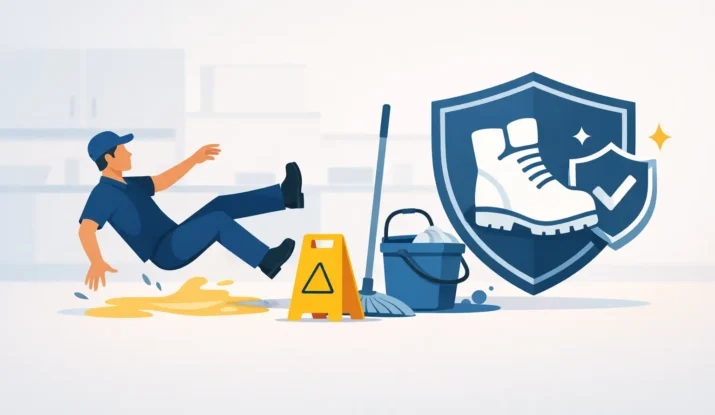
A cook rounds the line during a rush, hits a patch of oil near the fryer, and goes down hard. That is how fast a routine shift can turn into an injury report, lost labor, and a serious liability problem. If you need to prevent grease slip accidents in a commercial kitchen, the answer is not one fix. It takes consistent cleaning, better floor management, and a system your staff can actually follow under pressure.
Why grease slip accidents happen so often
Grease does not stay where it starts. It splatters from fryers, drips off equipment, travels on shoes and casters, and settles into grout lines, mats, and concrete pores. In a busy kitchen, that buildup can become part of the environment unless someone is actively removing it.
The problem is worse in high-volume operations because production and safety often compete for attention. During service, staff move fast, carry hot product, pivot in tight spaces, and work around wet cleaning zones. Even a small amount of grease can reduce traction enough to cause a fall, especially when it mixes with water, detergent residue, or food debris.
This is why slip prevention should be treated as an operational control, not just a housekeeping task. When grease is managed poorly, the risks stack up quickly – employee injury, workers’ comp claims, damaged morale, interrupted service, and unwanted attention during inspections.
The first step to prevent grease slip accidents
The first step is identifying where grease actually accumulates, not just where it is visible. Most operators pay attention to obvious problem spots like fryer banks and cook lines, but grease often spreads well beyond those areas.
Look at floor transitions, corners behind equipment, under prep tables, around floor drains, and along the path between the line and dish area. Pay attention to areas where staff stop, turn, or carry heavy loads. These are common slip points because traction is already compromised by movement, speed, and restricted visibility.
It also helps to distinguish between daily spill risk and long-term buildup. A fresh spill needs immediate response. Embedded grease in tile, grout, or concrete needs deeper cleaning. If you treat both problems the same way, you usually end up with floors that look acceptable at a glance but still feel slick underfoot.
Cleaning methods that actually reduce slip risk
Not all cleaning removes grease. In many kitchens, floors are being spread around, not degreased. A wet mop and bucket can pick up surface soil, but once the water is saturated with oil, it often leaves residue behind. That residue may not be obvious until the next rush.
A better approach starts with the right degreasing chemistry for the surface and the level of buildup. Dwell time matters. Agitation matters. Extraction matters. If the grease is not lifted and removed, it stays in place in some form.
For routine maintenance, staff should clean spills immediately, use fresh solution, and change mop water often. For problem areas, mechanical scrubbing is usually more effective than manual mopping alone. In kitchens with porous concrete, heavy fryer use, or longstanding buildup, periodic professional cleaning may be necessary to restore traction.
There is a trade-off here. Stronger degreasers can improve results, but if they are used incorrectly or not rinsed properly, they can leave floors hazardous in a different way. The goal is not the strongest chemical on the shelf. The goal is a floor that is clean, residue-free, and safe to walk on during normal operations.
Build a floor care schedule around real kitchen conditions
A written cleaning schedule is only useful if it matches the way your kitchen actually runs. Many slip hazards develop during peak production, not at closing. If cleanup only happens at the end of the night, grease can stay on the floor for hours while your staff works around it.
High-risk areas should have cleaning frequencies based on volume and equipment type. Fryer stations, grill lines, breading areas, and dish return zones often need attention multiple times per shift. Lower-risk zones may only require scheduled checks and end-of-day cleaning.
Assign responsibility by area, not by vague instruction. “Keep floors clean” is not a process. “Check fryer landing zone every 30 minutes and clean spills immediately” is a process. The more specific the expectation, the more likely it gets done consistently.
Managers should also verify, not assume. A checklist is helpful, but direct observation matters more. If staff are rushing, short-staffed, or improvising around equipment placement, slip hazards can develop even when a cleaning log appears complete.
Footwear, mats, and drainage all matter
If you want to prevent grease slip accidents, floor cleaning has to work together with the rest of the environment. Shoes, mats, drainage, and equipment layout all affect traction.
Slip-resistant footwear is a basic control, but quality varies. Some shoes perform well on dry floors and poorly on greasy ones. Others lose effectiveness as tread wears down. Operators should treat footwear as safety equipment, not just uniform policy.
Floor mats can help in some stations, especially around fryers and prep areas, but they are not a cure-all. Mats that curl, slide, or trap grease underneath can create new hazards. They need regular lifting and cleaning, and they must fit the space correctly. In tight line areas, a poorly placed mat can be as risky as an oily floor.
Drainage is another overlooked issue. If washdown water, grease, and food particles collect instead of moving cleanly to a drain, staff end up working on a contaminated surface for most of the shift. Standing water mixed with grease is one of the most dangerous combinations in a kitchen. In those cases, the problem may not be your cleaning frequency. It may be floor pitch, clogged drains, or the way the area is being washed down.
Train staff for fast response, not perfect conditions
The kitchen is never going to stay perfectly clean during service. That is why your team needs a realistic response plan for active slip hazards.
Staff should know what to do the moment a spill happens, who is responsible for responding, and how to isolate the area if immediate cleanup is not possible. That includes using the right absorbents or degreasers, posting floor warnings when needed, and avoiding shortcuts that spread the mess wider.
Training should also cover reporting. Near misses matter. If three employees mention that the same corner feels slick every night, that is a warning sign, not a minor complaint. The best time to fix a slip hazard is before someone gets hurt.
This is where management tone matters. If employees feel pressure to work through unsafe conditions because the line is busy, hazards go unreported. If safety is treated as part of production, not a delay to production, staff are more likely to act early.
When in-house cleaning is not enough
Some grease problems go beyond what an internal crew can handle consistently. That is especially true in older kitchens, under and behind heavy equipment, in exhaust-related drip zones, and on exterior service areas where grease tracks out from the back door or dumpster pad.
When buildup becomes embedded, repeated surface cleaning may not fix the traction problem. Professional grease removal can help restore floors, clean neglected areas, and support a safer maintenance baseline going forward. It can also reduce the burden on your staff, who already have enough to manage during operating hours.
For Las Vegas operators, this is often part of a larger compliance picture. Hood systems, ducts, fans, equipment exteriors, concrete pads, and kitchen floors all contribute to how grease moves through a facility. A specialist like Vegas Pressure Clean can address the source areas that in-house teams may not reach thoroughly, especially where fire risk and slip risk overlap.
Prevent grease slip accidents before they become claims
Most grease-related falls are not caused by one bad moment. They are caused by a pattern – delayed cleanup, incomplete degreasing, poor drainage, worn footwear, or buildup in areas nobody owns. That is good news from a prevention standpoint, because patterns can be corrected.
Start with your highest-risk zones. Watch how grease travels during a real shift. Tighten cleaning procedures where they break down. Reassess mats, shoes, and drainage if floors still feel slick after routine cleaning. And if the problem is deeper than your team can realistically solve during normal operations, bring in a qualified commercial cleaning partner.
A safer kitchen is not just cleaner. It is more stable, more compliant, and easier to run when the pressure is on. The right grease-control plan protects your staff first, and everything else gets better from there.
Comments (2)
Grease Cleanup Services for Commercial Kitchens – Vegas Pressure Clean
[…] first issue is slip risk. Back-of-house injuries often start with flooring that looks acceptable at a glance but still has a […]
Best Grease Cleanup Practices for Commercial Kitchens – Vegas Pressure Clean
[…] fryer splash behind the line can become a slip hazard before the next ticket prints. Grease tracked from the cook line to a walk-in, loading area, or […]