

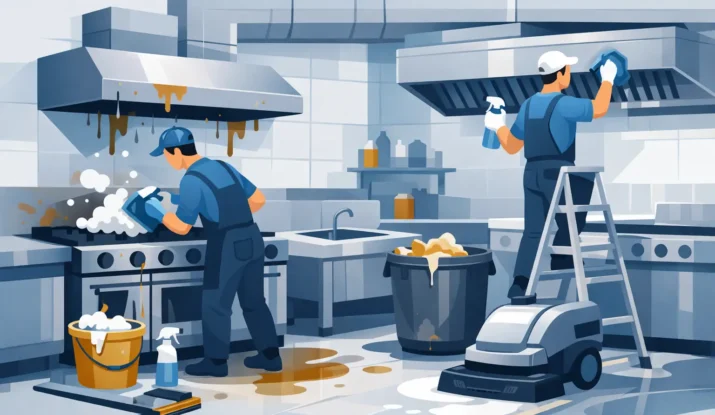
A grease spill behind the fry line does not stay a small problem for long. In a busy commercial kitchen, grease spreads under equipment, collects along edges, turns floors slick, and adds to the fire risk that already comes with high-heat cooking. Professional grease cleanup services are built for exactly this kind of problem – fast response, proper removal, and cleaning that supports a safer, code-ready kitchen.
What grease cleanup services actually cover
In commercial foodservice environments, grease cleanup is more than mopping a visible spill. It usually involves removing built-up grease from kitchen floors, wall areas, equipment exteriors, concrete pads, dumpster enclosures, loading zones, and other high-risk surfaces where oil and food residue collect over time.
For restaurants, hotels, ghost kitchens, casinos, and institutional kitchens, the issue is rarely limited to one surface. Grease migrates. It gets tracked by shoes and carts, splashes onto nearby equipment, seeps into grout lines, and settles into corners that routine janitorial cleaning does not fully address. A proper cleanup targets both the obvious mess and the residue left behind.
That distinction matters because residue is what keeps creating slip hazards, odors, sanitation concerns, and inspection problems after the visible spill is gone.
Why grease cleanup services matter beyond appearance
Operators are not calling for service because the floor looks bad. They are calling because grease affects safety, compliance, and daily operations.
The first issue is slip risk. Back-of-house injuries often start with flooring that looks acceptable at a glance but still has a thin film of oil on the surface. Staff moving quickly between stations do not get a warning before that becomes a workers’ compensation issue or a disruption during peak service.
The second issue is fire risk. Grease around cooking equipment, wall lines, and exhaust-related areas creates fuel where there should not be any. Hood, duct, and fan cleaning remains critical for fire prevention, but surface grease around the kitchen also matters. If buildup is allowed to continue, the overall fire load in the space increases.
The third issue is equipment performance and longevity. Grease buildup on surrounding surfaces and equipment exteriors traps grime, interferes with routine maintenance, and makes it harder to keep work areas sanitary. The longer it sits, the harder and more expensive it is to remove.
There is also the inspection factor. Health inspectors, fire officials, and facility auditors notice grease accumulation quickly. Even if the core concern starts with cleanliness, the conversation can move fast toward housekeeping practices, maintenance standards, and overall risk management.
Where commercial kitchens usually need grease cleanup
Most problem areas are predictable. Fry stations, cook lines, dish areas, hood perimeters, and spaces behind equipment are common trouble spots. So are outdoor areas connected to grease disposal, including pads near bins, enclosures, and service alleys where spills happen during transport or collection.
Concrete deserves special attention. Once grease penetrates porous surfaces, standard cleaning methods often stop working. The area may still look stained, feel tacky, or hold odors after a basic washdown. That is where specialized cleaning makes a difference.
In high-volume Las Vegas kitchens, buildup can also be worse than managers expect because operations run long hours, turnover can affect cleaning consistency, and equipment may not be moved as often as needed for deep maintenance. What looks like a manageable issue from the front edge of a line may be much heavier underneath and behind it.
Grease cleanup services and code readiness
Not every grease issue is a direct code violation, but many of them point to conditions that can create larger compliance problems. If grease is collecting in areas that should be maintained, it raises questions about housekeeping, hazard control, and whether related systems are being cleaned on schedule.
For foodservice operators, code readiness is not about waiting for an inspection and hoping the kitchen looks acceptable that day. It is about maintaining conditions that are consistently safer and easier to defend. Grease cleanup supports that by reducing accumulated fuel, improving floor safety, and helping kitchens present a cleaner, more controlled back-of-house environment.
It also works best when it is part of a broader maintenance plan. If a kitchen repeatedly needs emergency spill cleanup in the same areas, it may indicate a problem with practices, equipment condition, disposal handling, or missed deep-cleaning intervals.
What to expect from professional grease cleanup services
A commercial grease cleanup job should start with a clear scope. The service team should identify the affected areas, the type of buildup involved, the surfaces being treated, and any operational limits such as overnight access or sensitive equipment nearby.
From there, the work typically involves degreasing, pressure cleaning where appropriate, surface recovery, and removal of residue that standard mops and general-purpose cleaners leave behind. In some kitchens, that means focused interior cleaning around equipment bases and floor edges. In others, it means exterior concrete cleaning and spill remediation in service areas.
The right method depends on the surface. Tile, sealed concrete, unfinished concrete, stainless steel, and painted wall areas all respond differently. Overaggressive cleaning can damage finishes, while weak cleaning leaves behind the hazard. That is why experience matters.
Commercial operators should also expect practical communication. A serious vendor should be able to explain what will be cleaned, what results are realistic, whether staining is permanent, and how to schedule the work with minimal interference to service.
When to call for grease cleanup services
Some situations are obvious, such as a fresh spill near a dumpster pad or a heavy slick around a fryer bank. Others build gradually and get ignored because the kitchen is still functioning.
If floors stay slippery after routine cleaning, if grease is visible along wall lines or under equipment, if odors linger in back-of-house areas, or if exterior service zones are showing dark buildup and tracking, it is time to bring in a specialist. The same applies if your team is preparing for an inspection, recovering from a busy season, or trying to reset standards after staffing changes.
There is a difference between daily cleaning needs and specialty cleanup. In-house staff should handle routine sanitation, but hardened grease, runoff areas, and deep buildup often require commercial-grade equipment and technicians who work in fire-risk environments regularly.
Choosing the right provider for grease cleanup services
Not every cleaning company is built for commercial kitchen grease. General janitorial service may be fine for dining rooms and office areas, but grease around cooking operations calls for a narrower skill set.
Look for a provider that understands foodservice operations, works around business hours, and has direct experience with grease-related hazards. If the same company also specializes in hood, duct, and fan cleaning, that is often a good sign because they already understand the fire and compliance side of kitchen maintenance.
Responsiveness matters too. Some grease problems need scheduled service, while others need quick attention before they spread, harden, or interfere with operations. Clear estimates, reliable arrival times, and accountability on the job are not extras in this field. They are part of the service.
For Las Vegas operators, local experience is also worth considering. Kitchens in this market often run at high volume, late hours, and under constant pressure to stay inspection-ready without disrupting service. A vendor that knows those realities is usually better equipped to solve the problem efficiently.
Vegas Pressure Clean has built its work around that kind of environment, with a focus on commercial grease management, fire safety, and cleaning that supports compliance instead of just appearance.
The real value is fewer disruptions
The best grease cleanup services do not just leave an area cleaner. They help reduce the kinds of interruptions kitchen operators cannot afford – staff injuries, failed inspections, avoidable maintenance issues, and emergency cleanup that hits during the middle of service.
There is always a cost to calling a specialist, but there is also a cost to letting grease sit. Sometimes the right answer is a one-time cleanup after a spill. Sometimes it is recurring service because the kitchen produces enough volume to justify a scheduled approach. It depends on the operation, the layout, and how much grease the facility generates week to week.
What does not change is the standard. In a commercial kitchen, grease should be controlled before it becomes a safety issue, not after. If a problem area keeps coming back, that is usually your signal that routine cleaning is no longer enough and a professional cleanup will save time, risk, and frustration later.
A clean kitchen runs better when the hidden trouble spots get the same attention as the visible ones.