

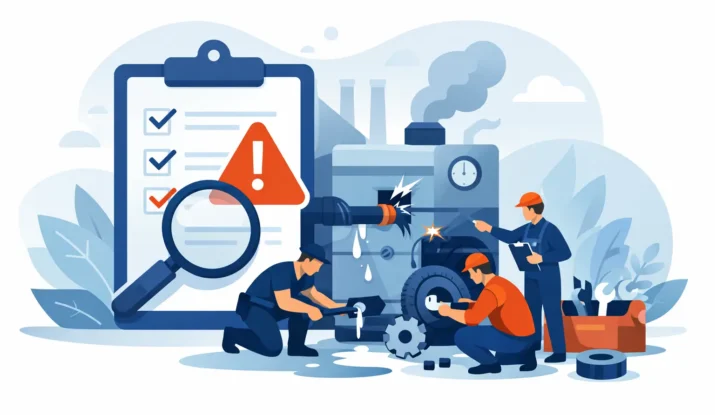
A failed inspection usually does not start with one bad moment. It starts with buildup that was ignored, rushed closing procedures, missed hood cleanings, grease on floors, and equipment that never gets fully cleaned because the kitchen is too busy to stop. In an inspection failure cleanup case, the real problem is rarely cosmetic. It is usually a mix of fire risk, sanitation issues, and maintenance gaps that have finally become too visible to overlook.
For restaurant owners and kitchen managers in Las Vegas, that kind of failure creates pressure on every side. You may be dealing with a fire inspector, a health inspector, a landlord, a brand standard audit, or an internal facilities review. Each one looks for different details, but the pattern is familiar. Grease has moved beyond the hood line. Floors are slick. Wall surfaces are loaded. Equipment legs and casters are surrounded by debris. The exhaust system may be overdue or cleaned only at the visible points, not throughout the full system.
What an inspection failure cleanup case usually involves
In most commercial kitchens, inspection failures are not caused by one isolated issue. They come from overlapping conditions that signal poor control of the back of house. A hood may look acceptable from eye level while the duct interior, fan, and rooftop access area tell a very different story. Floor drains may function, but grease runoff and residue around them can still raise sanitation concerns. A line can stay operational even while fryers, cook lines, and adjacent concrete are carrying heavy buildup that creates both slip hazards and pest attraction.
That is why an inspection failure cleanup case needs to be treated as a corrective action job, not a basic janitorial touch-up. The purpose is not to make the kitchen look better for a day. The purpose is to remove the conditions that caused the failure, document the work clearly, and reduce the chance of a repeat issue on the next inspection.
Why cleanup after a failed inspection needs a different approach
Routine cleaning and post-failure cleanup are not the same thing. On a normal maintenance schedule, the goal is to stay ahead of buildup. After a failed inspection, the goal is to correct specific deficiencies fast, without missing hidden areas that can cause another write-up.
That means the cleanup plan has to match the violation. If the concern is exhaust system grease, surface wiping around the hood canopy is not enough. If the concern is floor safety, a quick mop will not solve oil saturation in grout lines, under equipment, or on concrete paths near dumpsters and grease storage areas. If the concern is sanitation, you may need a deeper cleaning scope that includes splash zones, equipment exteriors, side panels, walls, and hard-to-reach areas behind the line.
Speed matters, but accuracy matters more. A rushed response can leave the kitchen looking improved while the real compliance risk stays in place.
The most common problem areas
In commercial foodservice spaces, failed inspections often point back to a few repeat trouble spots. Exhaust hoods, ducts, and fans are high on that list because grease accumulation directly affects fire risk. Cooking equipment is another major area, especially around fryers, charbroilers, and ranges where grease migrates to walls, floors, and nearby surfaces.
Concrete and exterior service areas also get missed more often than operators expect. Grease spills at loading zones, waste pads, and rear exits may not be the first thing a manager checks before an inspection, but those areas still affect safety and sanitation. The same goes for slippery walk paths and unmanaged runoff.
How to respond when the inspection fails
The first step is to read the report carefully and separate critical violations from supporting observations. Some items require immediate correction because they affect fire safety or public health. Others show a broader maintenance pattern but may not trigger the same level of urgency. You need to know which is which before scheduling work.
Next, look at the kitchen as an operating system, not a list of isolated surfaces. If there is grease dripping at the hood edge, ask what the ducts and fan look like. If the floor is slick near the line, ask what is happening behind and beneath the equipment. If one area failed, adjacent areas often need attention too.
Then bring in a specialist who understands commercial kitchen compliance, not just general cleaning. This is where experienced exhaust and grease-management contractors make a difference. A provider focused on hoods, ducts, fans, grease spill cleanup, and concrete cleaning can usually identify the true scope faster and recommend a corrective plan that aligns with inspection concerns.
Building the cleanup scope the right way
A proper inspection failure cleanup case should be scoped around the cause of the failure, the age of the buildup, and how the kitchen actually operates. A high-volume strip kitchen, a casino food outlet, and a small independent restaurant may all fail for grease-related issues, but the cleanup approach will not be identical.
Some kitchens need full exhaust system cleaning with access-point review and rooftop fan attention. Others need detailed equipment degreasing, floor pressure cleaning, wall cleaning, and spill containment work around grease storage areas. In many cases, the right answer is a combined service visit that addresses the exhaust system and the surrounding grease load at the same time.
There is also a timing question. If reinspection is close, you may need an immediate corrective cleanup followed by a second maintenance visit later to stabilize the kitchen. That is not overkill. It is often the practical choice when months of accumulation have to be corrected quickly without shutting the operation down longer than necessary.
Documentation matters more than most operators expect
Inspectors want corrected conditions, but management groups, landlords, and risk teams often want proof. That means service records, before-and-after photos when appropriate, and a clear description of what was cleaned. In fire-code-sensitive areas like kitchen exhaust systems, documentation is part of accountability.
If a vendor cannot clearly explain what was cleaned, what was found, and what still needs attention, that creates uncertainty on your side. In a failed inspection situation, uncertainty costs time.
What operators should avoid during cleanup
The biggest mistake is treating the failure like a one-time emergency instead of a maintenance warning. A kitchen can pass the follow-up inspection and still slide back into the same condition if there is no schedule behind the correction.
Another mistake is choosing the lowest quote without checking scope. Cheap cleanup after a failed inspection often means visible surfaces get attention while critical grease remains in ducts, fan housings, under equipment, or on exterior concrete. That can lead to another violation, and the second one is harder to explain.
Operators also need to avoid overloading staff with technical cleaning tasks outside their normal role. Line cooks and closers can handle daily sanitation tasks, but deep grease removal, hood system cleaning, and pressure washing around sensitive commercial areas require the right equipment and process. If staff are asked to solve a compliance-level problem without the right support, the result is usually incomplete.
How to reduce the risk of another inspection failure cleanup case
The long-term fix is consistency. That starts with scheduled hood and exhaust cleaning based on actual cooking volume, not guesswork. A kitchen running heavy fry and charbroiler production needs a different frequency than a low-grease operation. The schedule should reflect that reality.
It also helps to look beyond the hood. Equipment cleaning, floor degreasing, concrete cleaning, and grease spill response all support the same goal – a safer, more compliant kitchen that is easier to inspect and easier to run. When those services are handled as part of one maintenance strategy, the kitchen tends to stay under control.
Owner and manager walkthroughs matter too. Not because managers should do the cleaning themselves, but because recurring trouble spots need to be caught early. A five-minute check behind the fryers, under the hood line, at the rear service door, and around the grease area can tell you a lot about whether the cleaning plan is still working.
For Las Vegas operators, responsiveness is part of the equation. Kitchens run hard, inspection windows can be tight, and downtime has a real cost. Working with a local specialist who understands code-driven cleaning and commercial kitchen risk can shorten the path from violation to correction. That is where a company like Vegas Pressure Clean fits best – focused on exhaust, grease, compliance, and practical service that does not waste your time.
If you are dealing with an inspection failure, the best next move is not panic. It is a clear scope, the right cleanup, and a maintenance plan strong enough that the same issue does not come back next month.