

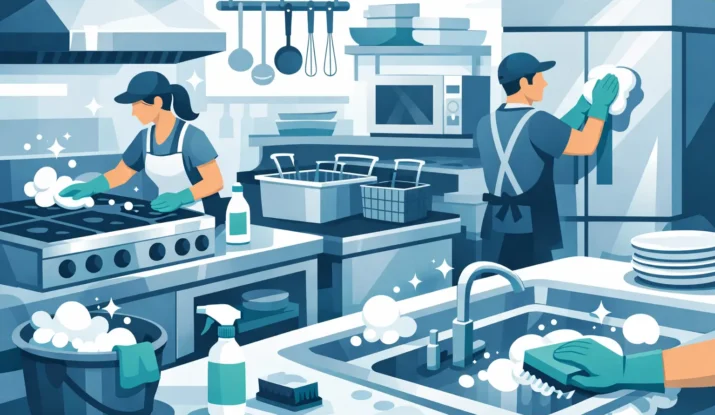
A fryer line can look manageable at closeout and still be carrying the kind of grease buildup that causes problems a week later. That is the reality of commercial kitchen equipment cleaning. It is not just about appearance. It affects fire risk, food safety, equipment performance, employee safety, and whether your kitchen is ready when an inspector walks in.
For restaurant owners, kitchen managers, and facility teams in Las Vegas, the standard is simple. Equipment has to stay clean enough to operate safely, hold up under heavy use, and support a compliant back of house. When grease collects around cooking batteries, under equipment, behind lines, and on surrounding surfaces, small issues turn into bigger ones fast.
Why commercial kitchen equipment cleaning matters
In a working kitchen, grease does not stay where it starts. Vaporized oils settle on nearby equipment, walls, casters, shelves, utility connections, and floors. Over time, that buildup becomes a serious hazard. It creates fuel for a fire, increases slip risks, attracts pests, and makes routine sanitation much harder.
There is also the equipment side of the equation. Burners, griddles, fryers, ovens, and surrounding prep stations perform better when residue is kept under control. Heavy buildup can interfere with airflow, heat transfer, and normal operation. That can mean slower recovery times, uneven cooking, extra wear on components, and more service calls.
For high-volume kitchens, waiting too long usually costs more than staying on schedule. Deep buildup takes longer to remove, may require moving equipment, and can expose issues that were hidden under grease and carbon. The longer it sits, the more disruptive the cleanup tends to be.
What gets missed during daily cleaning
Most kitchen teams handle routine wipe-downs and end-of-shift cleaning well enough to keep service moving. The problem is that daily cleaning and deep cleaning are not the same thing. Staff may clean visible surfaces every night while missing the areas where fire risk and sanitation problems actually build.
That usually includes the sides and backs of equipment, the space underneath cook lines, casters and legs, wall junctions, utility connections, filters, splash zones, and floor areas behind heavy units. In many kitchens, these are the places where grease hardens, dust sticks, and residue becomes difficult to remove with basic in-house methods.
It also depends on the operation. A burger concept with constant frying will have different cleaning demands than a hotel kitchen with mixed production or a fast-casual line with extended service hours. Frequency, menu, volume, and equipment layout all affect how quickly buildup returns.
Commercial kitchen equipment cleaning and fire prevention
This is where the stakes get real. Grease around cooking equipment is not just a housekeeping issue. It is a fire-load issue. Open flame, high heat, and flammable residue in the same area create obvious exposure, especially around fryers, charbroilers, ranges, and the equipment directly below hood systems.
A lot of operators think first about hood cleaning when they think about fire prevention, and they should. But the hood system is only part of the picture. If the surrounding equipment and surfaces are coated in grease, risk remains high. Fire can spread from the cook line to nearby surfaces faster when buildup has been allowed to accumulate.
That is why serious commercial kitchen equipment cleaning should be treated as part of a broader grease-management plan. Hood interiors, ducts, fans, cook equipment, floors, and adjacent surfaces all work together from a safety standpoint. Cleaning one area while neglecting another leaves a gap.
Where professional service makes the difference
Some kitchens can manage light-duty cleaning in-house for a while. But when equipment is used hard, runs long hours, or sits in a tight line, a professional cleaning crew brings a different level of results. The difference is not just stronger chemicals or better tools. It is knowing where buildup hides, how to clean without damaging components, and how to work around operational constraints.
Professional crews typically address accessible exterior surfaces, side panels, backs, undersides, floor areas beneath equipment, grease accumulation on nearby walls, and residue around cooking stations. Depending on the setup, service may also involve moving equipment carefully to reach blocked areas. That matters because some of the worst buildup sits where staff cannot easily access it during routine cleanup.
A qualified company should also understand the kitchen as a compliance environment, not just a dirty room. The goal is not to make metal shine for photos. The goal is to reduce grease hazards, support sanitation standards, and leave the kitchen in better operating condition without creating downtime you cannot afford.
How often should equipment be cleaned?
There is no single schedule that fits every kitchen. A 24-hour operation with heavy fryer use needs a more aggressive plan than a small cafe with limited hot-line production. The right schedule depends on volume, cooking methods, menu mix, hours, and how much grease vapor the equipment generates.
As a general rule, daily staff cleaning should cover food-contact areas and visible surfaces, while periodic deep cleaning should address the hard-to-reach zones that accumulate dangerous residue. If you are seeing sticky floors around the line, visible grease on equipment sides, recurring odors, or buildup behind units, the schedule is probably not keeping up.
Inspection history matters too. If your kitchen has had sanitation issues, grease-related slip concerns, or questions about housekeeping around cooking equipment, that is a sign to tighten the interval. It is easier to maintain a clean line with predictable service than to recover from a neglected one under pressure.
Choosing a provider for commercial kitchen equipment cleaning
Not every cleaning company is built for commercial foodservice work. For this kind of service, you need a provider that understands grease, code-sensitive environments, and the realities of restaurant operations. That means showing up on time, working around service hours, protecting equipment, and cleaning thoroughly enough to make the service worth scheduling.
Look for a company that is used to commercial kitchens specifically, not one that treats the job like general janitorial work. Experience with exhaust systems, fire-risk cleaning, and grease-heavy environments is a strong sign. So is a straightforward scope of work and a clear explanation of what will and will not be cleaned.
Local accountability matters as well. In Las Vegas, operators need vendors who know how fast high-volume kitchens can get away from staff cleaning, especially in hospitality, gaming, and franchise settings. A provider that is serious about compliance and quality control is usually the safer choice than one competing only on price.
That is the approach Vegas Pressure Clean is built around – practical service, honest estimates, and cleaning work centered on safety, grease control, and minimal disruption to operations.
What to expect from a well-planned cleaning visit
A good service visit should feel organized, not chaotic. The scope should be clear before work begins. Sensitive areas should be protected. Equipment should be cleaned with methods appropriate to the surface and the amount of buildup present. And when the job is done, your team should be able to see and feel the difference in the line, the floor, and the surrounding work area.
The best results come when cleaning is part of a routine maintenance plan rather than a last-minute response to a failed inspection or a dangerous grease condition. Emergency service has its place, but scheduled care is easier on the kitchen, easier on staff, and usually more cost-effective over time.
If your back of house is working hard every day, commercial kitchen equipment cleaning should not be treated as optional support work. It is part of keeping the kitchen safe, service-ready, and defensible from a compliance standpoint. When the line is clean where grease actually collects, everything around it works better – from inspections to safety to daily operations.
A clean cook line does more than look professional. It gives your team a safer place to work and gives you fewer surprises when business is already demanding enough.
1 Comment
How to Remove Floor Grease in Commercial Kitchens – Vegas Pressure Clean
[…] the surface. Focus on grout, corners, floor edges, underneath fryer batteries, and the space around cooking equipment legs. These are the areas where grease is repeatedly deposited and where routine mopping usually misses […]