

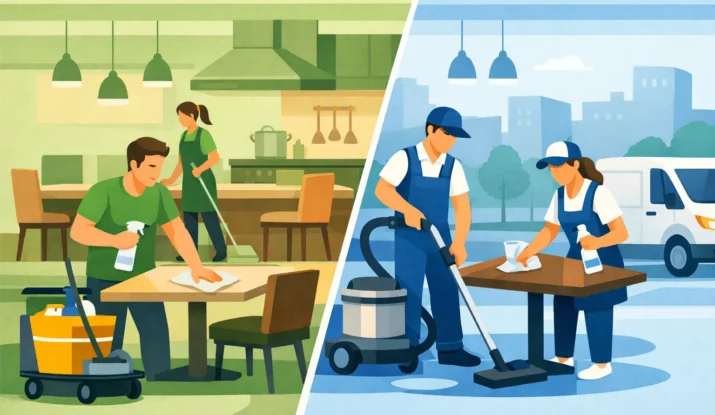
A busy Las Vegas kitchen can look clean at the end of a shift while grease continues to build where it creates the greatest risk: inside the hood, ductwork, exhaust fan, and around hard-working equipment. That is why the in house vs outsourced cleaning decision is not simply a staffing question. It affects fire safety, inspection readiness, labor costs, and whether your team can stay focused on serving guests.
For routine front- and back-of-house upkeep, an internal team may be the right fit. For kitchen exhaust systems, grease-heavy equipment, spill response, and other specialized work, outsourcing often provides a level of training, documentation, and accountability that is difficult to maintain internally. The right answer depends on the task, your operation’s volume, and the consequences if the work is missed.
In House vs Outsourced Cleaning: Start With the Scope
Not every cleaning duty requires the same skill, equipment, or level of oversight. Daily cleaning of prep surfaces, floors, dining areas, restrooms, and easily accessible equipment should be part of a restaurant’s normal operating routine. Kitchen managers can assign those responsibilities, inspect results, and correct issues before the next shift.
Exhaust hood cleaning is different. Grease is not limited to the visible hood canopy. It collects in filters, plenum areas, ducts, rooftop fans, and other parts of the exhaust path. Accessing and cleaning those areas correctly can require specialized tools, containment methods, degreasing products, roof safety practices, and knowledge of applicable fire-code requirements.
A useful dividing line is this: keep tasks in house when they can be completed safely, consistently, and verified by your staff during normal operations. Bring in a specialist when the work involves concealed grease, fire-risk systems, hazardous cleanup, difficult access, or compliance documentation.
What In-House Cleaning Does Well
An internal team has the advantage of being present every day. Employees see grease drips, overflowing trash, floor buildup, and equipment spills as they happen. That immediate awareness matters because small problems can become slip hazards, pest concerns, or expensive deep-cleaning projects when they are ignored.
In-house cleaning also gives managers direct control over timing. A kitchen can wipe down line equipment after service, empty grease receptacles according to procedure, clean filters on schedule, and address spills without waiting for an outside provider. For high-volume operations, these daily habits protect both sanitation and equipment performance.
The challenge is consistency. Restaurant teams are hired to cook, serve, manage inventory, and support guests. During a rush, cleaning tasks are often delayed, shortened, or passed to the next shift. Turnover can make it even harder to maintain training and accountability. A checklist helps, but only when someone has the time and authority to inspect it.
In-house work can also appear less expensive than it is. Labor hours, overtime, cleaning chemicals, replacement tools, workers’ compensation exposure, and supervisor time all belong in the calculation. If a manager repeatedly follows up on incomplete work, the internal cost is higher than the hourly wage on a schedule.
Where Outsourced Cleaning Adds Value
Outsourced cleaning is most valuable when a missed detail can create a safety, compliance, or operational problem. A qualified commercial cleaning provider brings technicians whose work is centered on specific cleaning tasks rather than divided among a dozen restaurant responsibilities.
For exhaust systems, that specialization matters. A provider should understand how to remove grease from accessible hood and duct components, protect surrounding kitchen areas, clean rooftop exhaust fans where applicable, and leave clear service documentation. The goal is not to make the hood look better from the cook line. The goal is to reduce combustible grease buildup throughout the system.
A specialist also brings the appropriate equipment and process. Commercial degreasing, pressure cleaning, grease containment, and difficult-access work are not projects that should be improvised with basic janitorial supplies. Proper methods help protect kitchen surfaces and reduce the chance of sending grease-contaminated water into areas where it does not belong.
Scheduling is another advantage. A reliable contractor can perform work during off-hours or at times that reduce disruption to service. For restaurants, casinos, hotels, and multi-unit operators, this is often more practical than asking staff to complete heavy cleaning after a long shift.
Outsourcing does not remove the need for management oversight. It changes the type of oversight. Instead of assigning the work, managers should confirm scope, frequency, credentials, completion records, and the condition of the system after service.
Cost: Compare the Full Cost, Not the Invoice
The lowest quote is not always the lowest cost, and internal labor is not automatically the cheaper choice. Compare each option based on the full work required to achieve a safe, repeatable result.
With in-house cleaning, consider paid labor, training time, turnover, supplies, equipment, safety gear, supervision, and the possibility that the task will need to be redone. If the work requires employees to access roofs, work around electrical equipment, handle heavy grease, or clean areas they cannot properly reach, risk becomes part of the cost as well.
With outsourced cleaning, consider the provider’s experience, scope of work, service frequency, after-hours availability, documentation, and reputation for showing up as scheduled. A clear estimate should explain what is included instead of leaving you to discover later that ducts, fans, filters, or cleanup are separate charges.
For many kitchens, the best financial approach is a blended one. Staff handles daily sanitation and routine wipe-downs. A qualified contractor handles scheduled hood, duct, fan, equipment, concrete, or grease-management work that requires specialized attention. This keeps labor focused while reducing the risk of expensive surprises.
Compliance and Fire Safety Cannot Be Casual
Commercial kitchen exhaust systems exist to capture heat, smoke, vapors, and grease-laden air. When grease accumulates, it becomes fuel. A fire that reaches the hood or duct system can travel beyond the cooking area quickly, putting employees, guests, property, and business continuity at risk.
Cleaning frequency should be based on your cooking volume, menu, equipment, and the requirements that apply to your facility. High-volume frying, charbroiling, and other grease-producing operations generally need more frequent attention than lower-volume kitchens. Your fire authority, insurer, lease terms, and internal safety standards may all influence the schedule.
This is where outsourced expertise can be especially useful. A specialist who focuses on exhaust and fire-risk cleaning understands that the job must be performed thoroughly, not cosmetically. Ask whether the company is properly licensed for the work, insured, experienced with commercial kitchens, and able to provide clear proof of service. In Nevada, operators should also verify relevant State Fire Marshal requirements for the service being performed.
Vegas Pressure Clean has focused on commercial exhaust and grease-management work since 2002, with owner-led quality control and Nevada State Fire Marshal licensing. That kind of specialized accountability is what restaurant operators should expect when selecting a provider for safety-critical cleaning.
Questions to Ask Before You Decide
Before keeping a cleaning task in house, ask whether your employees have the time, training, access, and equipment to do it correctly every time. Also ask who will inspect the work and what happens when the assigned employee calls out, leaves the company, or gets pulled into service.
Before outsourcing, ask the provider to define the cleaning area, service schedule, preparation requirements, completion process, and documentation. Confirm whether the quoted work includes the hood, filters, accessible ducts, exhaust fan, surrounding equipment, and any needed grease cleanup. A professional provider should answer directly and avoid vague promises.
It is also wise to separate routine cleanliness from compliance-critical cleaning in your maintenance plan. A spotless floor does not prove that the exhaust system is safe. Likewise, a professionally cleaned hood system does not replace daily sanitation by the kitchen team. Both responsibilities matter, but they require different systems of control.
Build a Cleaning Plan That Holds Up During a Busy Week
The strongest cleaning programs are practical enough to survive a Friday night rush. Assign daily and weekly tasks to internal staff, name the manager responsible for inspection, and keep supplies available where they are needed. Then schedule specialized cleaning before buildup becomes a problem rather than after an inspection, equipment issue, or grease spill forces an urgent call.
If you are uncertain where internal responsibility should end, walk your kitchen with a safety-first mindset. Look beyond visible surfaces, review your service records, and choose qualified help for work that carries fire, compliance, or access risk. A clear plan protects your people, your equipment, and the service your guests depend on.