

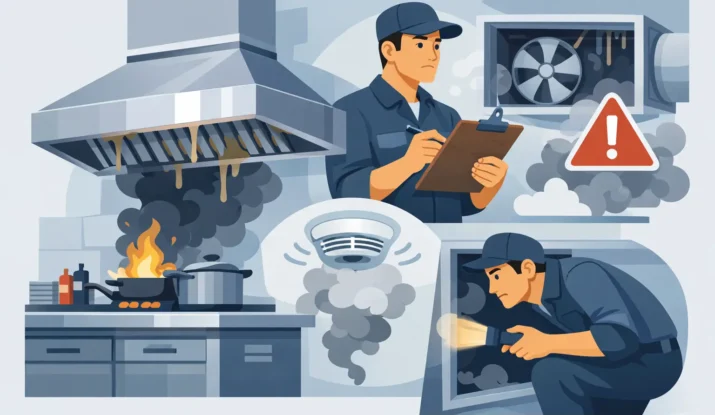
A failed hood inspection usually does not come down to one dramatic problem. More often, it is a stack of smaller issues that built up over time – grease left in the duct, a fan that was never checked, access panels that make cleaning incomplete, or paperwork that does not match the actual service condition. If you are asking why kitchen exhaust fails inspection, the answer is usually simple: the system is no longer being maintained to the standard your operation requires.
For restaurant owners, kitchen managers, and facility teams in Las Vegas, that matters for more than paperwork. A kitchen exhaust system is tied directly to fire safety, day-to-day airflow, and your ability to keep service running without interruptions. When inspection problems show up, they often point to a deeper maintenance gap that needs to be corrected before it turns into a shutdown, a fire hazard, or a repeat violation.
Why kitchen exhaust fails inspection in real operations
In the field, inspection failures usually happen because grease was allowed to collect where it should not be, or because parts of the system were overlooked during service. Many operators assume the visible hood tells the whole story. It does not. Inspectors and fire officials are concerned with the full path of the exhaust system, including the hood, filters, ductwork, access points, fan, and surrounding roof area.
A hood can look acceptable from the kitchen line and still fail because the duct interior is heavily coated. The opposite also happens. A contractor may clean deeper components but leave exposed surfaces, filters, or fan hinges in poor condition, which raises immediate concerns about maintenance quality and code compliance.
Another common issue is inconsistency. Some kitchens run light volume and can go longer between service visits. Others push grease-heavy production every day and need more frequent attention. When cleaning schedules are based on habit instead of actual cooking volume, the system often falls behind long before the next inspection.
Grease buildup is still the biggest reason
The most common answer to why kitchen exhaust fails inspection is grease accumulation. That includes grease in the hood plenum, on filters, inside horizontal and vertical duct runs, and around the exhaust fan assembly. Once buildup reaches a certain level, it is not just dirty – it becomes a fire fuel source.
Inspectors are not looking for a polished appearance alone. They are looking for whether the system has been cleaned to bare metal where required and whether grease deposits remain in areas that can ignite or restrict proper operation. Thin residue may be expected in some situations shortly after service, but heavy grease, pooling, or dripping is a clear problem.
This is where shortcuts show up fast. If a crew only cleans what is easy to reach, leaves hinge kits unused, skips fan blades, or avoids difficult duct sections, the system may appear serviced on paper while still failing in practice. High-volume kitchens, especially those producing fried food, charbroiled items, or wok cooking, are at greater risk because the grease load is much heavier.
Incomplete cleaning leaves hidden failure points
A kitchen exhaust system fails inspection when cleaning is partial instead of complete. That usually happens in one of three ways. The first is when service is limited to visible hood areas. The second is when access to the duct system is poor and nobody corrects it. The third is when the fan and rooftop components are ignored.
Duct interiors are often the problem area
Ductwork is where hidden grease becomes an inspection issue. If there are not enough access panels, or if existing access points are too small or badly placed, technicians may not be able to clean the full run effectively. Over time, grease layers build in bends, long horizontal sections, and hard-to-reach transitions.
An inspector who sees signs of residue at an access point may assume, correctly in many cases, that the problem continues deeper into the line. Even if the kitchen-facing hood looks clean, the system can still fail because the actual fire risk is above the ceiling or behind the wall.
Exhaust fans tell inspectors a lot
The fan assembly is another frequent weak point. Grease on the fan blades, motor housing, hinge area, or rooftop containment can indicate poor maintenance. A fan that cannot open properly for cleaning creates a service limitation. If grease is collecting on the roof membrane or around the curb, that can also trigger concern beyond the exhaust system itself.
For operators, this matters because fan problems affect more than inspection outcomes. They can reduce airflow, increase kitchen heat, and put more strain on the equipment.
Damaged or missing components can trigger a failure
Not every failed inspection is about dirt alone. Mechanical condition matters. Filters that are missing, damaged, or installed incorrectly can affect grease capture and airflow. Access panels that do not seal correctly may violate code requirements and make future cleaning harder. Fan hinges, electrical disconnects, and containment components all need to be in proper working condition.
When parts are loose, broken, or improvised, inspectors may view the system as unsafe even if recent cleaning was performed. That is especially true if the condition suggests grease can escape, airflow is compromised, or service cannot be performed safely.
This is one of the biggest trade-offs operators face. Choosing the lowest-cost service may handle surface cleaning for the moment, but it often does not address damaged hardware or system defects that will continue causing compliance issues. Proper maintenance costs more upfront than a quick spray-and-go job, but it usually costs less than repeated failed inspections and emergency corrections.
Documentation and service intervals matter more than many operators expect
A kitchen can be cleaned and still run into problems if the service record does not support the condition of the system. Inspectors often want to see proof that the exhaust system has been maintained at the right frequency for the cooking operation. If the sticker is outdated, the records are missing, or the cleaning interval does not fit the actual grease load, questions come quickly.
Frequency should match cooking volume
Not every kitchen needs the same schedule. A school cafeteria, a 24-hour diner, a casino kitchen, and a light-duty prep space do not produce grease at the same rate. If your schedule is too far apart for the volume and type of cooking you do, the system may fail even if you technically stayed on your own calendar.
This is where experienced guidance matters. A proper cleaning schedule should reflect your operation, not a generic estimate.
What inspectors are really looking for
Most inspectors are not trying to make your life harder. They are checking whether the system presents an avoidable fire risk and whether it has been maintained in a way that supports safe operation. That means they are looking for overall condition, not just one shiny surface.
They will notice excessive grease, but they also pay attention to signs of neglected service. Dripping residue, inaccessible duct sections, heavy rooftop grease, missing labels, damaged components, and poor workmanship all point to a system that is not being managed properly. In many cases, the failure is not a surprise. The warning signs were already there in the form of smoke issues, hot kitchen conditions, odor, fan strain, or visible grease around the hood and roof.
How to prevent a failed inspection before it happens
The best way to avoid inspection trouble is to treat exhaust cleaning as a fire safety requirement, not just a cleaning task. That means using a qualified provider, making sure the full system is cleaned, addressing mechanical issues when they are found, and setting a schedule based on actual use.
It also helps to look beyond the hood line. If grease is collecting on nearby equipment, walls, rooftop areas, or floor surfaces, there is a good chance the exhaust system is overdue or not being serviced thoroughly enough. These are early indicators that should not be ignored.
For busy commercial kitchens, prevention is mostly about consistency. The operators who avoid repeat issues are usually the ones who keep records organized, respond quickly to deficiencies, and work with specialists who understand what inspectors and fire officials expect. That is the standard Vegas Pressure Clean is built around.
If your kitchen has had airflow issues, visible grease, or a recent warning from an inspector, it is better to correct the problem now than wait for the next visit to confirm it. A clean exhaust system supports safer operations, fewer disruptions, and a lot more confidence when inspection day comes around.
Comments (2)
Kitchen Exhaust Maintenance Guide for Restaurants – Vegas Pressure Clean
[…] Las Vegas, maintenance is also about continuity. A system that falls behind on cleaning can trigger inspection failures, emergency service needs, and avoidable downtime. That is a hard cost, especially when service […]
What Happens After a Failed Inspection? – Vegas Pressure Clean
[…] inspection carries the same consequence. A minor documentation issue is very different from heavy grease accumulation in the exhaust system or unsafe conditions around cooking equipment. Inspectors typically classify […]